· tech · 3 min read
A Primer on Quantum Computing in Mid-2026
A short intro to quantum computing, how it works, and where it's heading.
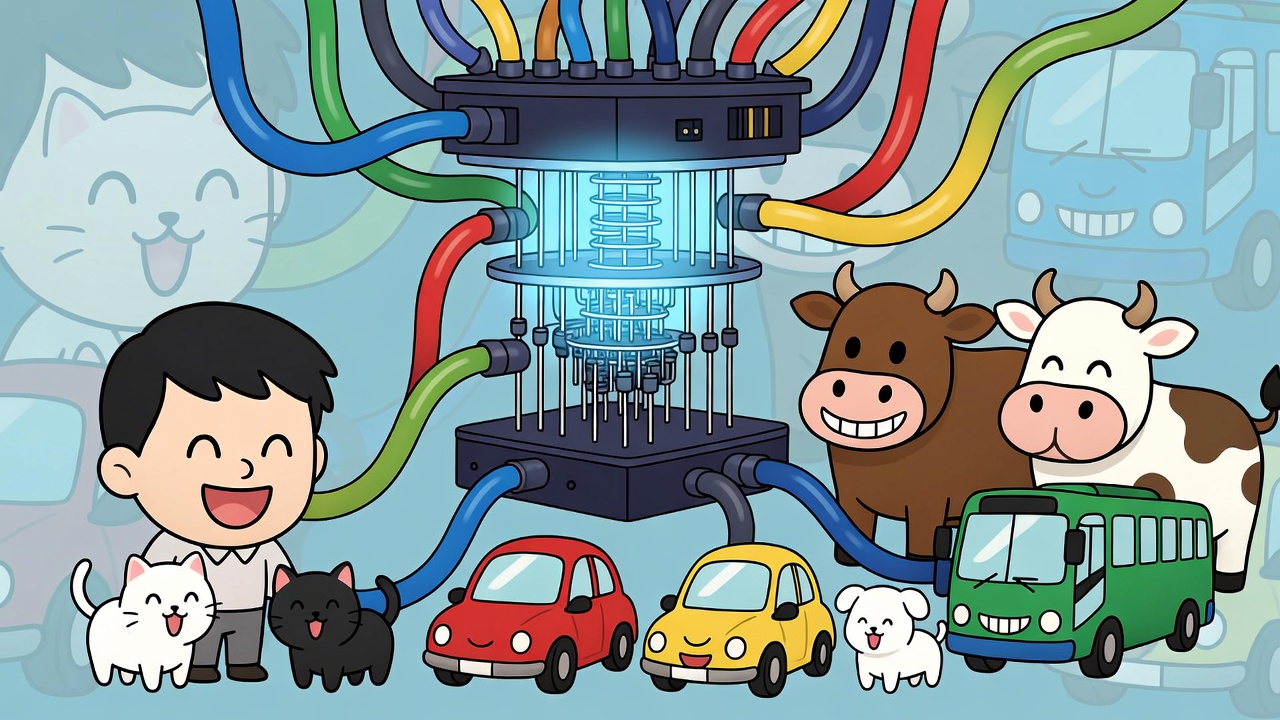
Do you enjoy comics or fantasy tales? Good news - superpowers and magic are real. They are called Theory of Relativity and Quantum Mechanics.
Back in 1687, Newton described why apples fall and planets move. His Theory of Gravity works perfectly… unless you move very fast or zoom in very closely. Enter Einstein, who, while working as a patent clerk, started poking holes in Newton’s rules. His Theory of Relativity rewrote the cosmic playbook. It shows that space and time are linked, and that time can slow down or speed up depending on how fast you move or how close you are to massive objects. It feels alien. Yet there is an even weirder micro-world theory that Einstein himself struggled to come to terms with: Quantum Mechanics. It tells us that the smallest particles can exist in multiple states at once (superposition), affect each other instantly over distance (entanglement), and that outcomes are fundamentally probabilistic rather than certain. It’s completely bonkers, yet these effects are measured in labs every day, and your phone wouldn’t work without them.
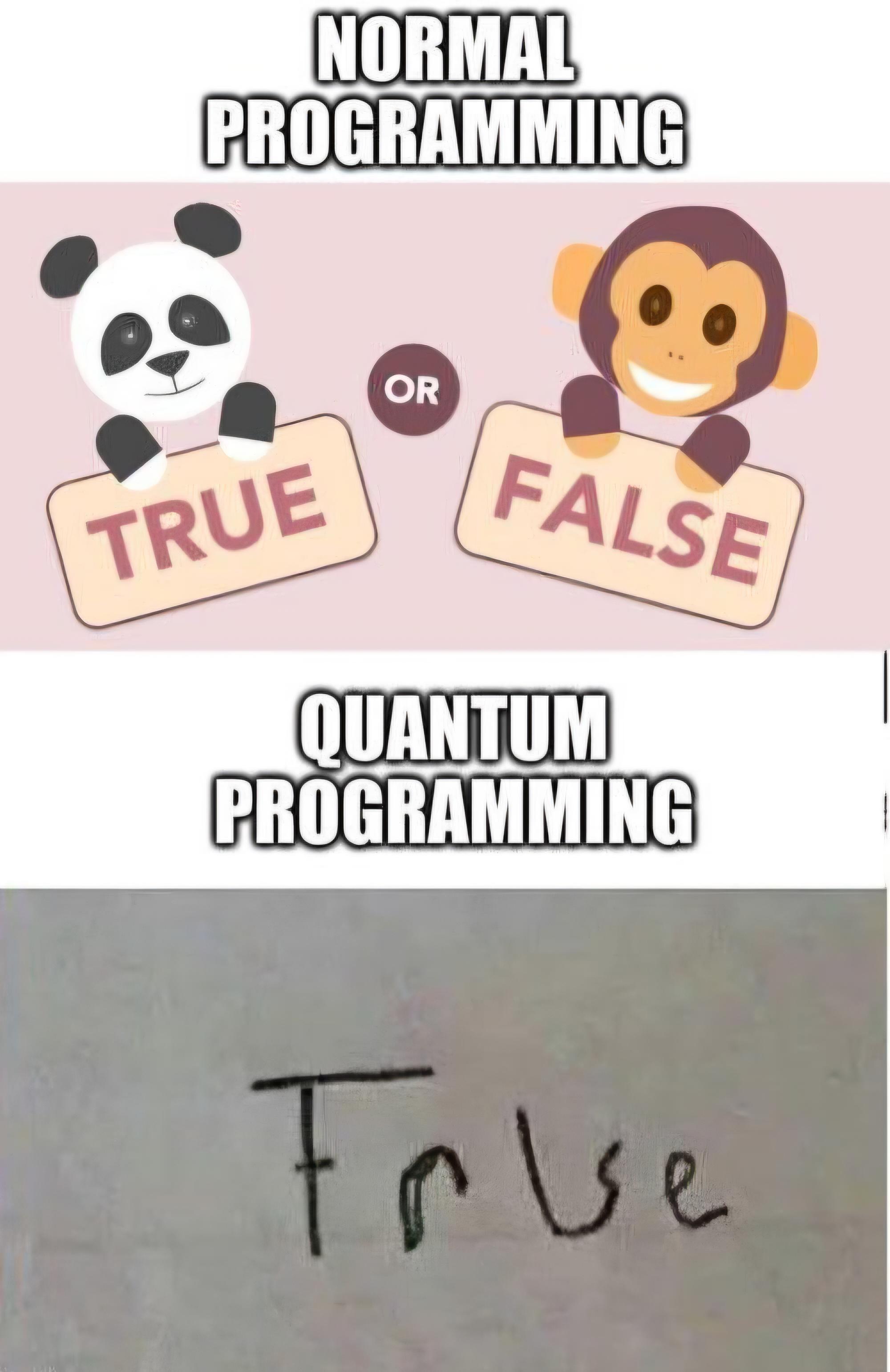
Quantum has all the answers
(c) Unknown
Quantum computing uses these quantum effects to process information in ways that classical computers cannot. Instead of bits that are 0 or 1, quantum bits (qubits) can be both at once, allowing certain calculations to be done much faster - in theory, almost infinitely faster as their speed scales exponentially with the number of qubits.
A prime example of a certain calculation is, um, prime factorization - that is, solving 15 = 5 * 3. That doesn’t seem too hard, unless 15 is replaced with a very large number. The only known way to solve this on a normal computer is by checking a lot of possible combinations. Even on a fast supercomputer, this could take centuries. Many encryption mechanisms, such as the popular RSA, rely on this. Yet, in theory, a powerful quantum computer could use Shor’s algorithm to check all the options at once instead of one by one.
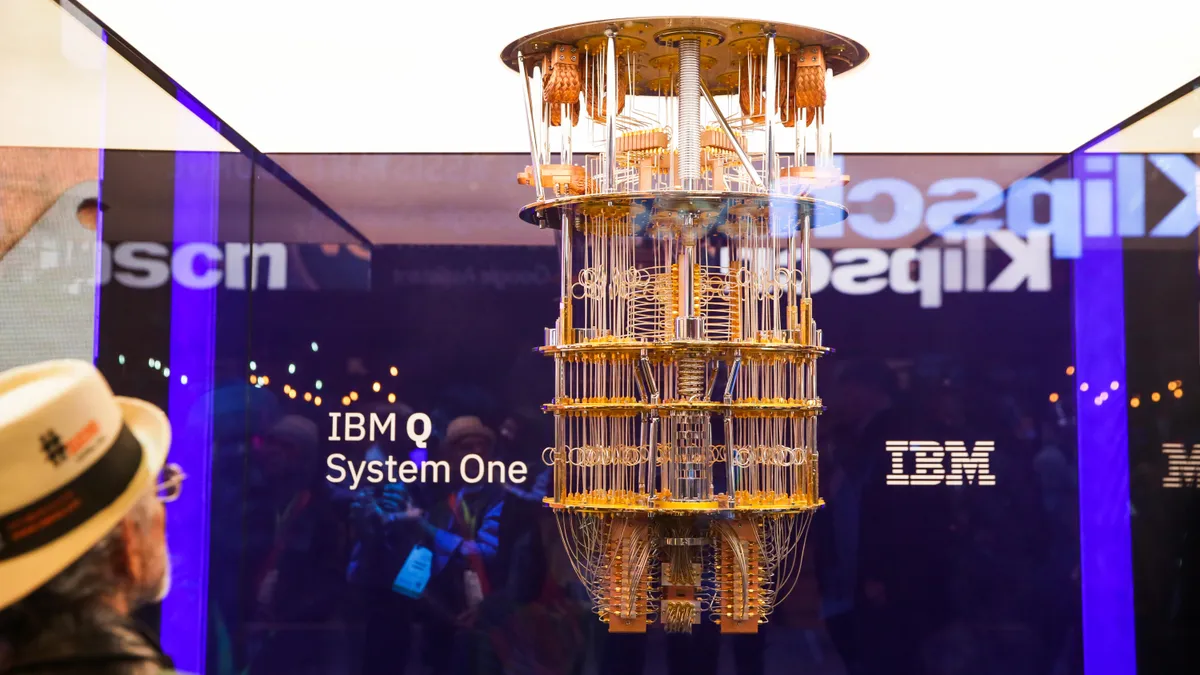
Quantum computers have rizz
(c) CNET
Reality is different: fancy quantum ~~chandeliers~~ computers are extremely sensitive to noise, and keeping qubits stable is a major engineering challenge. Classical computers are still better at just about everything. Yet quantum hardware is steadily getting better. In early 2026, we saw big leaps forward in the number of qubits and error correction.
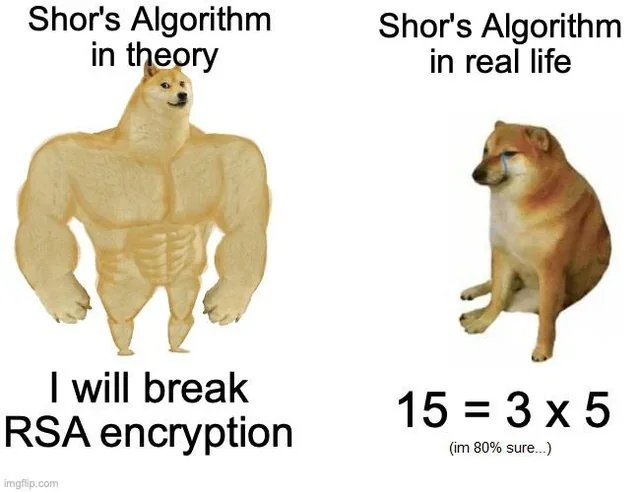
Shor will not only break RSA; it will also break ECC encryption, and with it, Bitcoin! (I’m almost sure.)
(c) Unknown
The hardest part actually might be the software, aka quantum algorithms. Only a few exist. There are limited uses. Years went by without new breakthroughs. Is it the quiet before the storm, or a permanent drought?
Prediction: Eventually, one future day will be called Q-day - the moment when quantum computers break today’s widely used encryption. New quantum algorithms could potentially deliver a total computing revolution. This is not a gimmick - the science is proven. The potential is huge. But for now, real-world uses are rare, and the timeline for mainstream impact is uncertain.